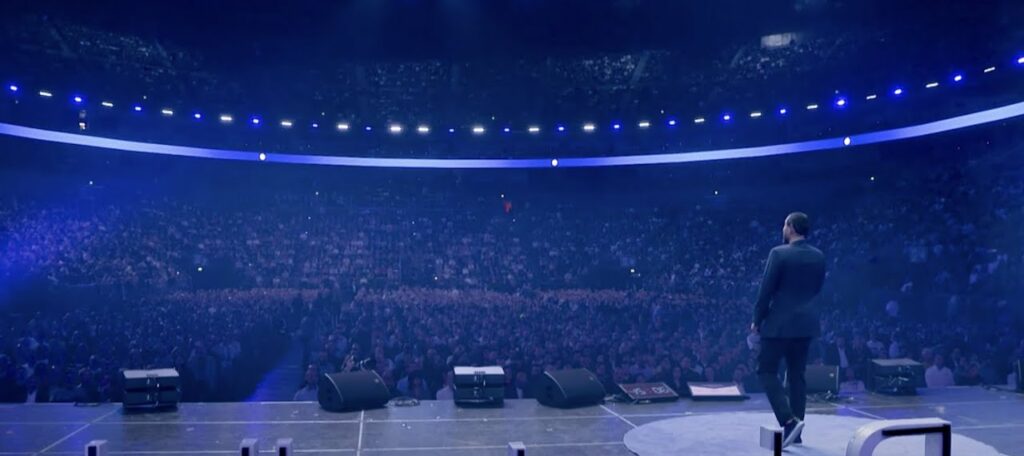


How executives use events to shape perception
Pillar: Leadership Identity
There is a version of the executive keynote that has not aged well. The CEO walks on stage, reads a deck about the company’s last quarter, says some encouraging words about the future, and walks off. The audience claps. Nothing changes.
There is also another version. An executive walks on stage with no deck, says something specific and slightly uncomfortable that no one else in the industry is saying, and changes the conversation for the next twelve months.
The difference between those two appearances is not preparation. Both are prepared. The difference is what the executive understands about the role of presence in live experience, and how to use a stage to do something a press release cannot.
A stage is a different instrument
A stage is not a press release with a microphone. The room rewards conviction, specificity, and the willingness to say something that could be wrong. It punishes corporate language, hedge phrases, and answers that have clearly been through legal four times.
Executives who treat a stage like a release valve for messaging waste the room. Executives who treat it like an instrument, a chance to say something true and specific to a room of decision-makers, leave with the audience repeating their words for months.

What strong presence actually looks like
The executives who land on stage share a small set of habits. Once you know what to look for, the difference between a forgettable keynote and a transformative one becomes visible inside the first ninety seconds.
- They speak in short sentences.
- They tell stories with concrete details, not abstractions.
- They hold a clear point of view and they are willing to be wrong about it in public.
- They take questions that have not been pre-screened, and they answer the question that was actually asked.
- They use silence. Five seconds of nothing lands harder than the next sentence will.
Three signs an executive is wasting the room
- Reading from a deck the audience could have read on their own.
- Refusing the unscripted question.
- Disappearing into a green room until the car arrives.

Presence is built before the stage
The executive who shows up well on stage almost always shows up well in the room before and after. They arrive on time. They eat with the audience. They take three real conversations with people who do not have a title above theirs. They write follow-up notes by name within forty-eight hours.
The audience watches all of this. The keynote is the visible part of presence. The rest is what makes the keynote believable. An executive who delivers a brilliant talk and disappears into a green room until departure leaves a different impression than one who stays and engages, and the audience never forgets which they got.
A press release reaches more people. A stage changes more minds. They are not the same instrument.

For the executives investing in this
The right number of stage appearances per year is not high. Most executives are better served by three exceptional appearances than ten average ones. The math is not about exposure. It is about the durability of impression each appearance leaves behind.
When you do appear, treat the room as the most important deliverable on your calendar that quarter. Prepare for it the way you would prepare for a board meeting that mattered. Show up early, stay late, and let the stage be the moment that consolidates the case you have already been making in private.
A simple test before the next appearance
Before the next time you walk on stage, ask three questions. If the answers are not honest and specific, the appearance is going to underperform regardless of the venue.
- What is the one thing I am willing to say here that I would not say in a press release?
- What story will I tell that the audience cannot find on a podcast?
- How will I behave in the room before and after the talk so the talk is believable?
Related in this series: for the conditions that make presence land, see The Power of the Right Room and Programming That Commands Attention.
At TCAA, we work with the leaders at the top who expect nothing less than the power of the right room.